Jessica Loredo • Edmentum • February 2020
Today Exact Path is a personalized learning platform used by millions of K–12 students. When expanding the product to serve K–2 learners, we couldn’t simply scale down an existing experience. Younger students have fundamentally different cognitive needs, reading abilities, and expectations around feedback and progress.
This case study focuses on the design of the K–2 student experience, including navigation, learning flow, and engagement patterns that support independent, joyful learning.
The Problem
Designing for early learners is not the same as designing for older students
The existing Exact Path student experience was built for grades 3–5. When applied to K–2 learners, it created confusion, frustration, and cognitive overload.

Key Challenges Included:
- Too many visible choices competing for attention
- Progress indicators that were abstract or unclear
- Navigation patterns that assumed reading fluency
- Lost progress when students navigated away mid-activity
- An experience that required adult support to complete tasks
At the same time, we were operating within real constraints:
- A rigid curriculum and diagnostic framework
- Legacy content and technology limitations
- Fixed timelines and limited development bandwidth
The challenge was to design a system that felt simple and empowering to young learners, while still aligning with the broader product architecture.
The Approach
Research-driven decisions grounded in child cognition. To design responsibly for early learners, we combined:
- Classroom observation and informal usability testing with K–2 students
- Feedback from educators familiar with early literacy and numeracy development
- Iterative prototyping focused on comprehension, not speed
Rather than optimizing for efficiency, we optimized for clarity, demonstrating progress, and emphasizing encouragement. My background in game design helped inform how structure, repetition, and feedback loops could support motivation without overwhelming students.


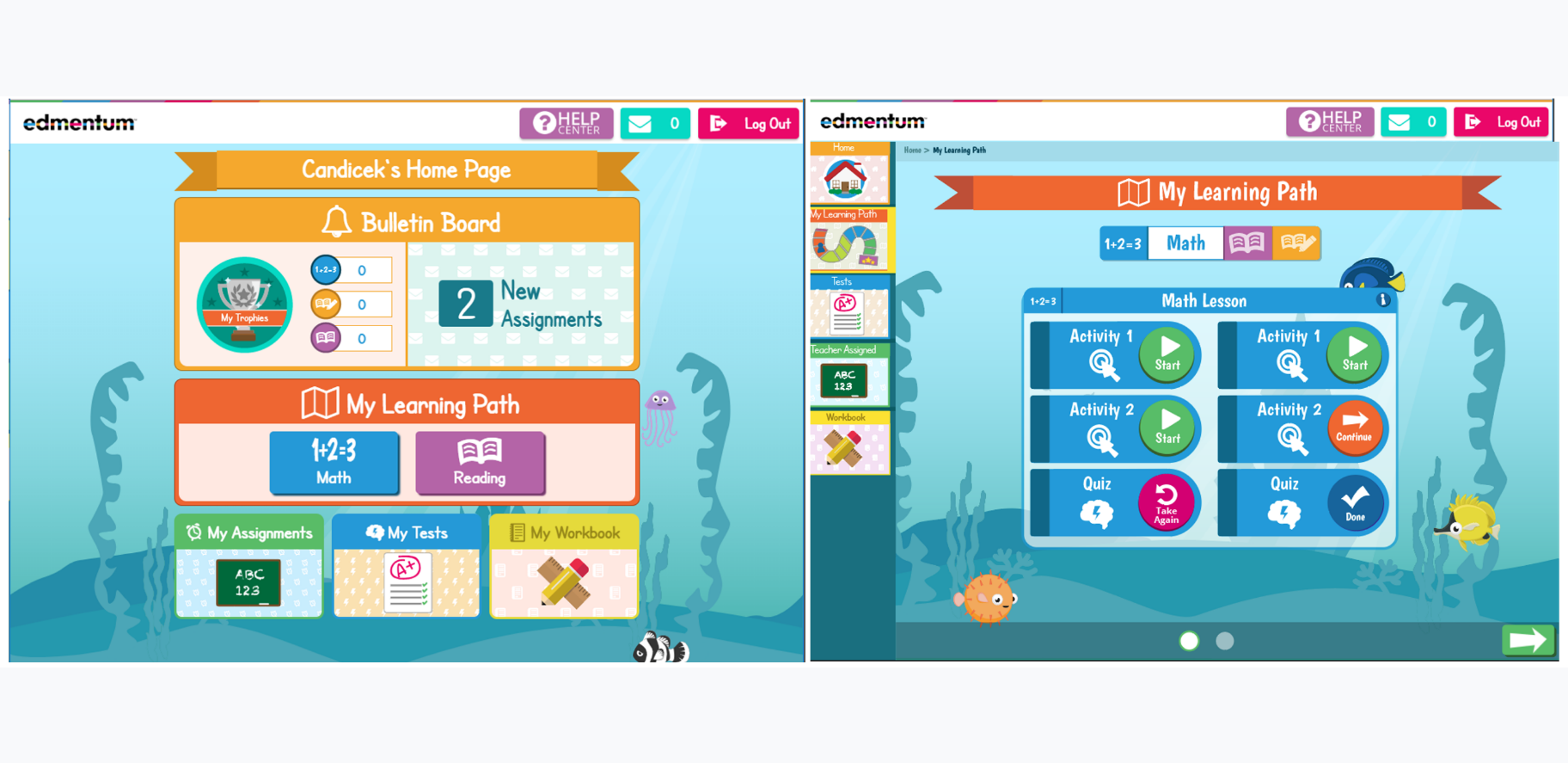
Design
A system built to reduce cognitive load and support independence
Key Design Decisions:
- Simplified Navigation: Reduced visible options to help students focus on one task at a time.
- Clear Progress Cues: Board-game-inspired progress indicators made advancement tangible and motivating.
- Automatic Saving (Bookmarking): Ensured students never lost work, reducing anxiety and disengagement.
- Age-appropriate Login and Entry points: Designed for pre-literate and early-reader users.
- Moments of customization and delight: Small personalization elements gave students a sense of ownership without distraction.
Each decision was evaluated through a lens of "Can a six-year-old understand what to do next without help?"

Results & Impact
A joyful more focused learning experience for early learners.
- Improved task completion without adult intervention
- Reduced confusion around where to go next
- Increased student confidence and willingness to continue
- Positive qualitative feedback from educators observing student use
Most importantly, the system proved durable. The foundational architecture and interaction patterns remain intact as the product evolved over time (five years later as of 2025, the core architecture is still used).

As of 2025, the platform’s student and educator experiences have earned industry recognition from Tech & Learning, CODiE, Tech Edvocate, and EdTech Awards for personalized, adaptive learning and progress monitoring, reflecting the durability of the underlying design.
Reflect
Designing for children requires restraint, not simplification.
This project reinforced that designing for young learners is not about removing features—it’s about removing assumptions. I learned the importance of:
- Advocating for usability even under tight constraints
- Designing systems that support emotional safety, not just task completion
- Letting clarity do the work instead of visual complexity
Many of the principles established here, progressive disclosure, cognitive load management, and system durability, continue to influence how I approach platform design today
I feel a deep sense of gratitude for having played a key role in the first design of Exact Path’s student experience, beginning with grades 3–5 and later extending to K–2 learners. Designing the foundational architecture for how students move through an individualized adaptive learning path, and seeing those patterns endure, reinforced for me the value of thoughtful systems design.
Knowing this work has supported learners and educators over many years, and across classrooms around the world, continues to shape how I approach platform design today.
Want to read more? You can read the full case study published on Notion
Full Case Study arrow_forward